
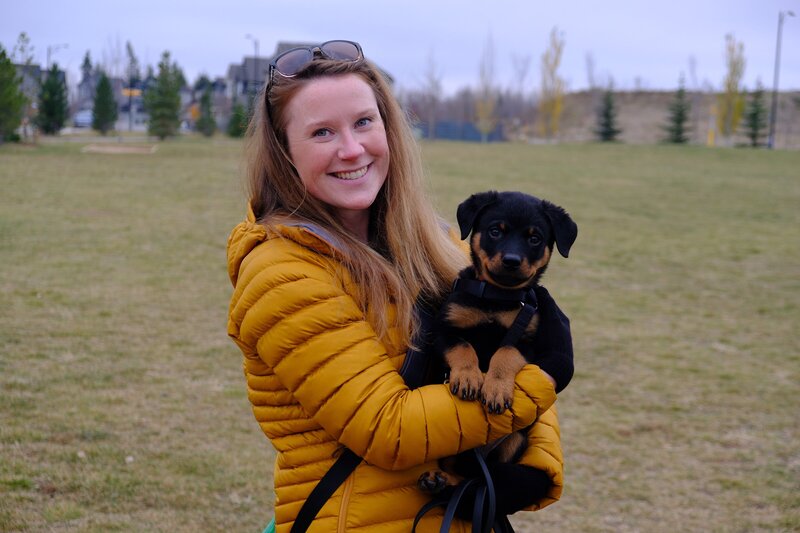




I recently sat down with five other dog trainers to discuss all things puppy! If want to raise a happy, well-trained pup, be sure to check out the full video here:
Want to receive exclusive tips, training insights, and all the latest updates straight to your inbox? 🐾 👉 Sign up for my free newsletter here
Here are 3 important puppy training reminders from our discussion:
1) Puppies Are Always Learning
During the discussion, Kelly asked a great question: “How do you balance the need for training with allowing puppies to just be puppies?”
Puppies need time to play, explore, sleep (18+ hours a day), eat, and more. Their days are packed with “puppy stuff”.
So, how does training fit into all of that?
Puppies have short attention spans (as demonstrated when Ahsoka, mid-sentence in my “Train Your Puppy to Sit” tutorial, decided to take a break and tackle one of my plants!).
Instead of aiming for long training sessions, you can achieve great results by incorporating several short, five-minute training sessions throughout the day.
And remember, puppies are always learning—whether or not we think we’re actively training them.
Did jumping on you get attention? That’s learning.
Did chewing on the couch leg earn attention? That’s learning.
Did settling quietly with a toy get rewarded? Yep, that’s learning too!
Proper training goes far beyond obedience.
During the discussion we all agreed that key areas like socialization (see point 3), cooperative care & grooming, desensitization to new sights and sounds, puppy biting, and more should be the primary focus for young puppies.
This brings us to the next two important points:
2) Pay Attention to What You Like
Let’s be honest—puppies are adorable, but exhausting! When they finally settle down and are “being good,” it’s tempting to let them be, right? We need a break too!
But, as we mentioned in point 1, puppies are always learning. With positive reinforcement we say, “What gets rewarded, gets repeated.”
Consider these two scenarios:
- Your puppy quietly chews on a toy by themselves. You leave them alone, so the puppy learns that doing this gets them no attention.
- Your puppy bites your ankle. You squeal, then bend down to pick up the puppy before they can do it again.
Which behaviour got your attention?
Now, which behaviour do you think they’re more likely to repeat?
Oops!
It’s absolutely crucial to give your puppy positive feedback when they’re doing something you like. The easiest way to do this? Keep treat jars in multiple spots around your home so you can quickly mark and reward your puppy for desirable behaviour.
Playing with the right toy? Mark and reward.
Settling quietly on their mat when guests are over? Mark and reward.
Noticed the mailman but stayed calm? Yep, mark and reward!
These small moments have a huge impact on your puppy’s behaviour in the long run.
3) Socialization ISN’T Just Socializing
When we think of socialization, we often think of it in human terms—maybe having people over for dinner or grabbing coffee with a friend. We often equate socializing with doing things with other people.
That’s why many puppy owners assume that socialization means their puppy should spend time with other dogs. However, letting your puppy greet every dog they encounter can backfire and even cause frustration reactivity.
So, if socialization isn’t just about playtime with other dogs, what is it?
Socialization means exposing your puppy to new experiences and environments in a positive way. Whether it’s new people, sounds, or objects, the goal is to ensure your puppy forms positive associations with the unfamiliar.
Essentially, it’s any new experience for your puppy (like a vacuum) that you introduce carefully, ensuring they have a positive experience and develop a good association with the new thing.
Think of puppy socialization as confidence building.
Ask yourself: If my puppy experiences this new situation (like traffic noise) in this way, how will they feel about it in the future?
If you’re unsure, break it down into smaller, less overwhelming steps! For example:
Instead of walking them down a busy road (which exposes them to loud traffic noise), start by playing a YouTube clip of traffic sounds at a low volume while they enjoy a stuffed Kong at home.
This combination of “low-level stimulus + treat” helps your puppy build positive associations with the sound of traffic, preventing fears down the road (pun intended). Gradually increase the volume as your puppy becomes more comfortable, eventually achieving real world levels without fear.
I hope these three puppy training tips help you raise a happy, well-trained little pup!
If you found this blog post helpful, please consider sharing it! Want more training tips? Sign up for my free newsletter here or check out my Youtube channel here.
Disclosure: Happy Hounds uses affiliate links. Purchasing with these links will not cost you any extra, but I get commissions for purchases made through these links. Affiliate links help me to continue to offer free resources & blog posts. I would love if you used them!
3 Important Puppy Training Tips You Need to Know!
About the author:





+ show Comments
- Hide Comments
add a comment