

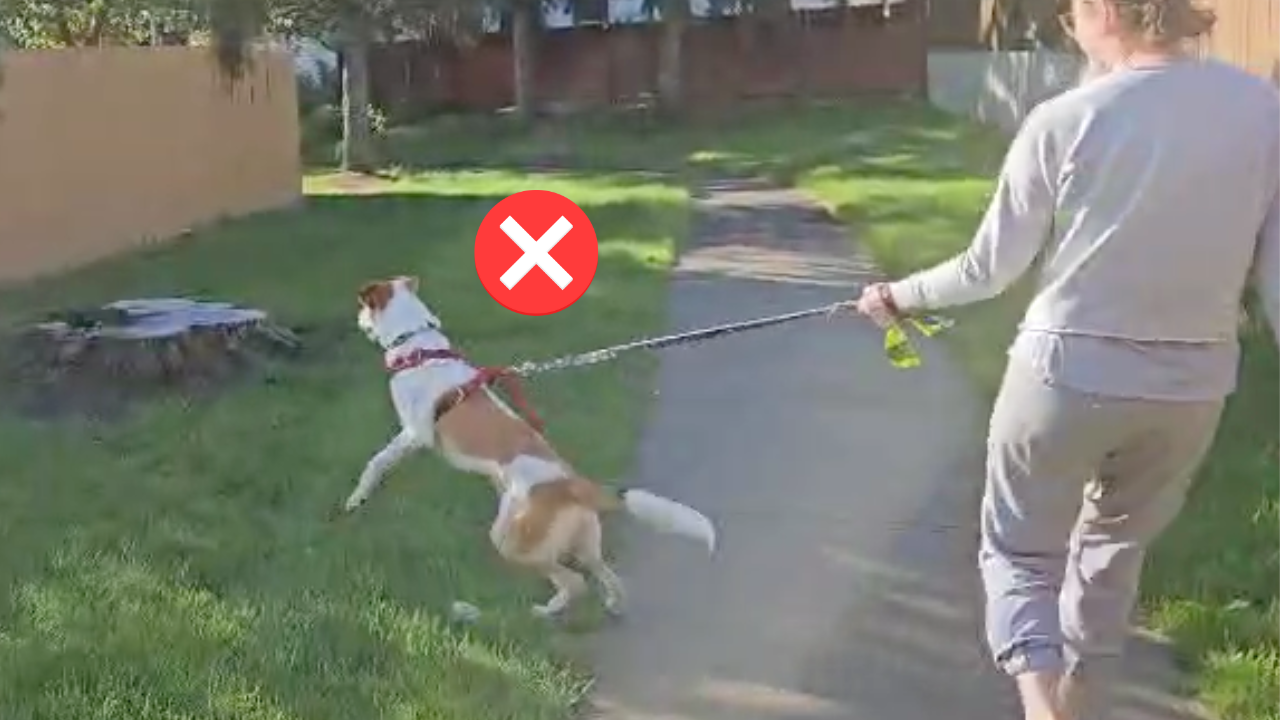


Have you ever experienced this? You’re in a quiet, low-stimulation setting, and your dog is walking on leash like a dream—no tension, no pulling.
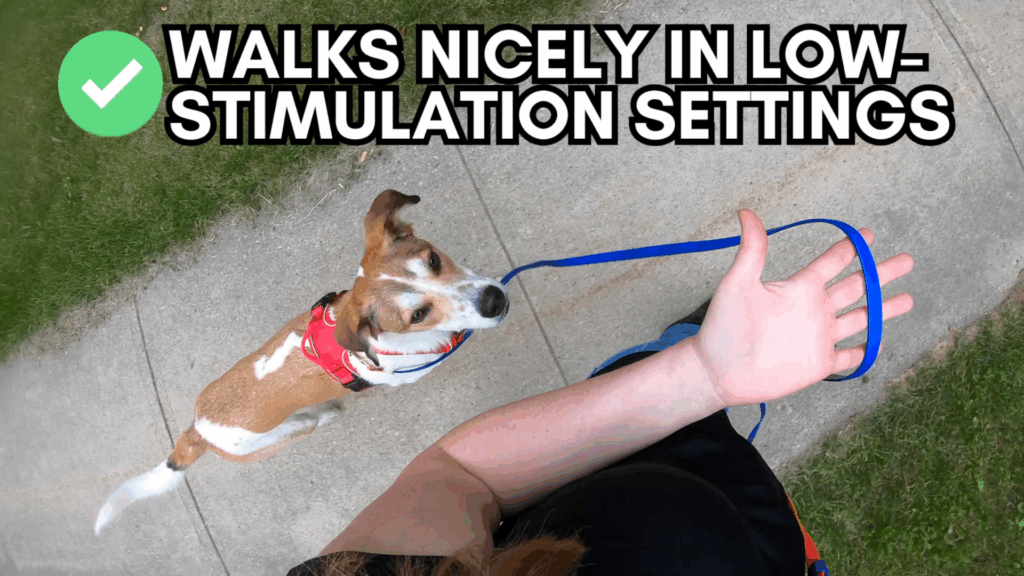
But then a distraction pops up—maybe a cyclist, another dog, or a squirrel. Instantly, your dog is overstimulated and pulling on leash.
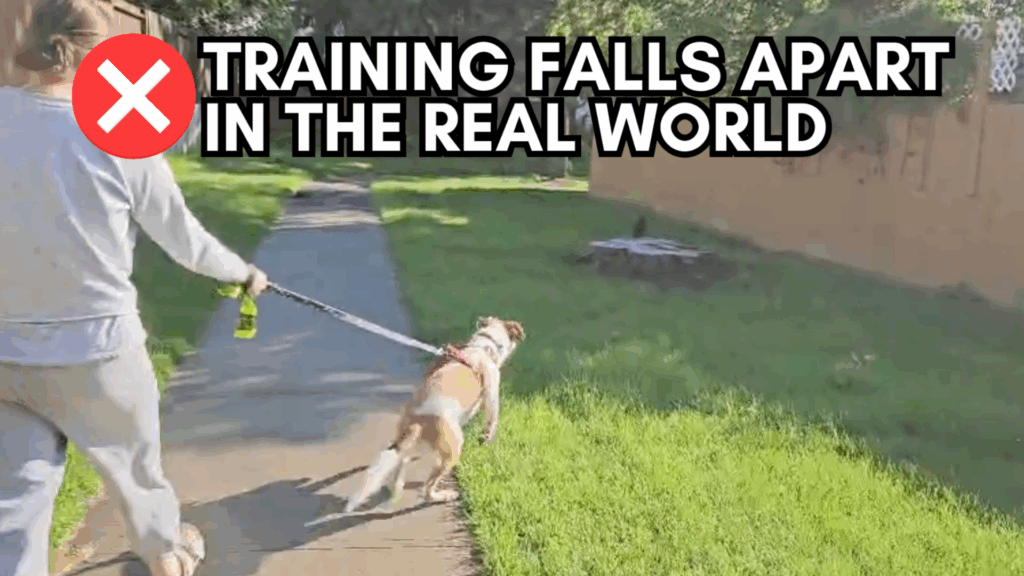
If your dog can walk nicely on leash in calm settings, but their leash training falls apart in the real world, this post will explain why—and how to fix it. And no, it’s not because your dog is stubborn, and it’s not because treats don’t work!
Today, I want to share the closest thing I know to a cheat code for leash training in the uncontrollable real world—and exactly how I use three simple techniques to transform walks with dogs like my client Gus.
➡ Video version: For those who like visual demonstrations, I also have a video version of this demonstrating the techniques and sharing bonus tips. Watch: 3 Simple Ways to Make Leash Training Work in the Real World
Why Leash Training Falls Apart in the Real World:
Most people are accidentally leash training their dogs incorrectly.
Picture this: I bring you into a chaotic, messy garage and ask you to grab a specific item. I’ll even reward you with the world’s best donut. But I give the instructions in a language you don’t understand, and you need to get it right on the first try.
How successful could you be?

Probably not very.
Not because you don’t want the donut, but because the environment is too chaotic for your current skill set.
Now imagine being in an empty space with just that one item.
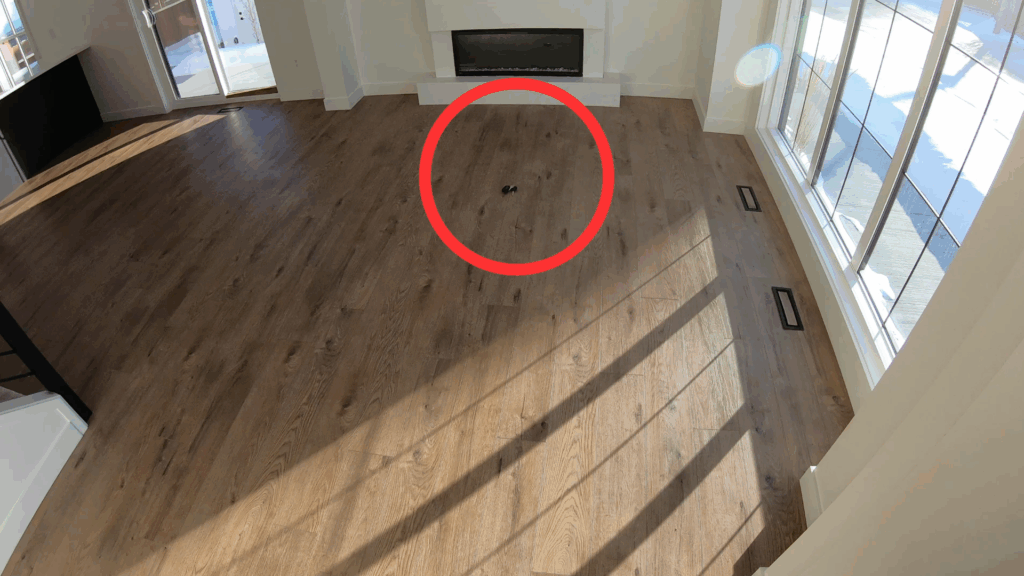
When I ask you to grab the keys, how successful could you be?
Likely very, because I’ve removed all the wrong choices.
As your skills improve, I can slowly add more items and more distractions- until eventually, you could succeed even back in the cluttered garage.
This is the same foundation for proper reward-based leash training.
Positive reinforcement means rewarding the behaviours we want repeated, like walking with a loose leash. But here’s the part people often miss: For reinforcement to work, the dog has to be able to succeed in the first place.
It’s our job as the handler to structure training so that our dog can offer the behaviour we want, and so that there is something to reward.
However, most people start their dog at too difficult a level by beginning leash training out in the “real world”. This is the equivalent of starting you in that cluttered garage!
This is exactly why I always suggest starting leash training indoors where you can build foundational skills. Think of this like starting your dog in that empty room: you’re making the right choice, the easy choice.
➡ Video tutorial: Watch this video for my exact leash training process: How to Train a Dog to Heel: Step-by-Step Tutorial to Stop Leash Pulling!
But this leads to an obvious question: What do you do when you actually have to walk your dog outside?
If starting indoors is like starting with one item, and the real world is like a chaotic garage, how do you progress from one to the other?
I live and train dogs in a large city, so I completely understand the struggle.
Even if you choose training locations carefully, you obviously can’t control cyclists, barking dogs, other animals, construction, traffic—any of it. So if effective leash training requires setting our dogs up for success, how do we do that in a world that we can’t control?
The answer is management.
Dog Training vs. Management: Why You Need Both
Management is the closest thing I know to a cheat code for bringing real life down to your dog’s training level. Using it properly will transform your dog walks!
So, what’s the difference between management and training?
Let’s pretend that we are working on window reactivity.
How could we use both management and training to solve window barking?
I define training as teaching a new desirable behaviour. It answers the question, “How do I want my dog to act in this situation?”
If you want your dog to calmly watch people outside the window, then training is reinforcing that new way of acting.
Management, on the other hand, is anything that prevents the rehearsal of the unwanted behaviour. So, in this case, it’s anything that prevents window barking. This could include using window film to block their view or moving your furniture so that your dog can’t see outside.
➡ Video: If you need help with your dog’s window activity, watch this: How to Stop Window Barking (Step-by-Step Window Reactivity Training)
Management doesn’t replace training—it amplifies it.
By preventing the rehearsal of unwanted behaviours, your structured training sessions become clearer, faster, and much more effective.
Management is often the missing piece in successful leash training.
Gus’s Story
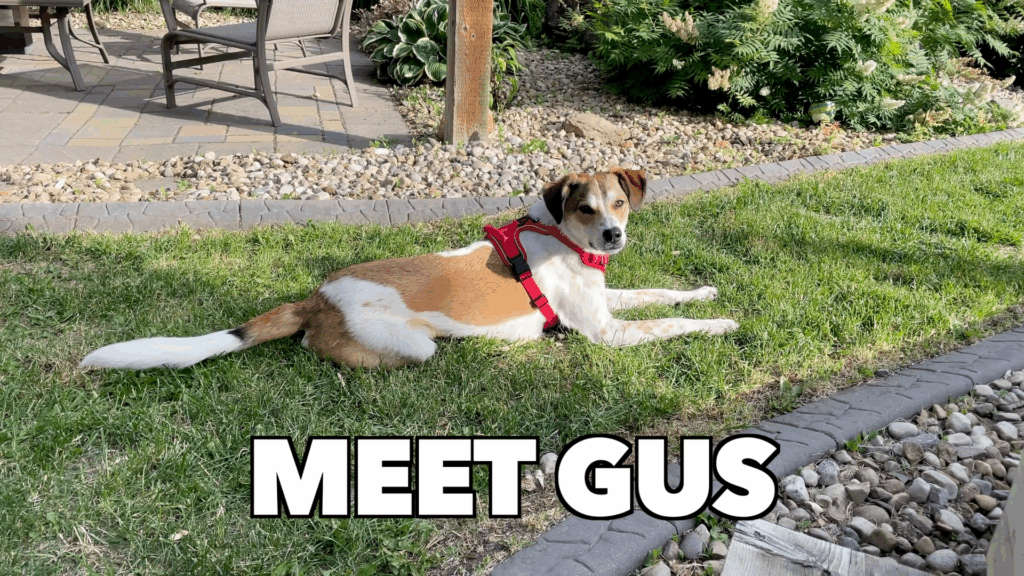
Gus’s guardians had stopped taking him on walks because they were too overwhelming. He reacted to people, dogs, bikes, animals—basically everything—and had zero leash skills.
Even in a low-stimulation environment, he pulled constantly.
After a few indoor training sessions to build foundational skills, it was time to take that training outside.
Management is what made those outdoor sessions effective. By using well-rehearsed management techniques, I could keep Gus’s real-world experience at a level he could handle—so we could continue to progress his leash skills step by step.
Three Management Techniques for Real-World Dog Walks
Here are the three management techniques I use with every client, including Gus, to make walks calm and successful:
1. Kong Hand
Kong hand helps guide your dog past distractions using high-value treats.
- Say a cue word, like “Gus, Kong.”
- Then slowly feed out the treats (using them as a lure) to keep your dog focused on you instead of the distraction.
It’s especially useful for situations your dog isn’t ready for or would pull toward. Using Kong Hand buys time and distance and prevents pulling.
Tips:
- Use a cue word so your dog doesn’t think they can always grab the treats in your hand.
- It takes practice to feed out the treats in motion, so practice at home!
- Keep a high rate of reinforcement when distractions are strong.
2. Up-Down Pattern Game
This game is from Leslie McDevitt, whose book I’ve linked here. It helps reset overstimulation and encourages your dog to engage with you:
- Drop a treat on the ground.
- When your dog looks back at you, mark and reward.
Modifications:
- For dogs that grab or steal food, I like to say “okay” or “yes” as I drop the treat to let them know they can take it.
- Rewarding from your hand when they look up at you reinforces engagement.
I use this game:
- When leaving the home to help the dog adjust to the stimulation of going outside.
- On walks whenever the dog is getting too stimulated and needs a reset.
Think of it as a 15-second break from the chaos of the real world.
➡ Want my full, step-by-step leash training program? Check out my guide with text, photos, and linked video tutorials to take your dog from a complete beginner on leash to one that can handle busy, real-world environments.
3. Emergency U-Turn
The emergency U-turn lets you quickly turn your dog in the opposite direction without leash tension. It’s useful for avoiding situations your dog isn’t ready for, like passing other people or dogs, while keeping them at a manageable distance for successful training.
How to train an emergency U-turn:
- Verbal cue + treat lure: Say your dog’s name, cue “With me,” and lure them in the opposite direction. Give at least two treats while walking in the new direction to encourage them to follow you without looking around to see why you turned. Repeat this 10 times.
- Phase out the lure: Cue your dog “With me!” and turn, this time without holding a treat in front of their nose. Reward them when they follow.
Tip: Every time you use this skill to avoid a real distraction, repeat it later when nothing is there. This ensures your dog will continue to respond without hesitation.
Why Management Protects Your Dog Training
Now, you might be thinking, “Aren’t these just avoidance techniques? What if I actually want my dog to be able to handle everything in the real world?“
I do too!
But proper training for all of the situations that might come up in the real world does take time. Until your dog is ready, management keeps situations manageable—and protects your training!
Whenever you use management for something you want your dog to eventually handle, make a mental note and add a structured version to your training plan for later.
✅ If you want neutrality when going past other dogs, you can train that.
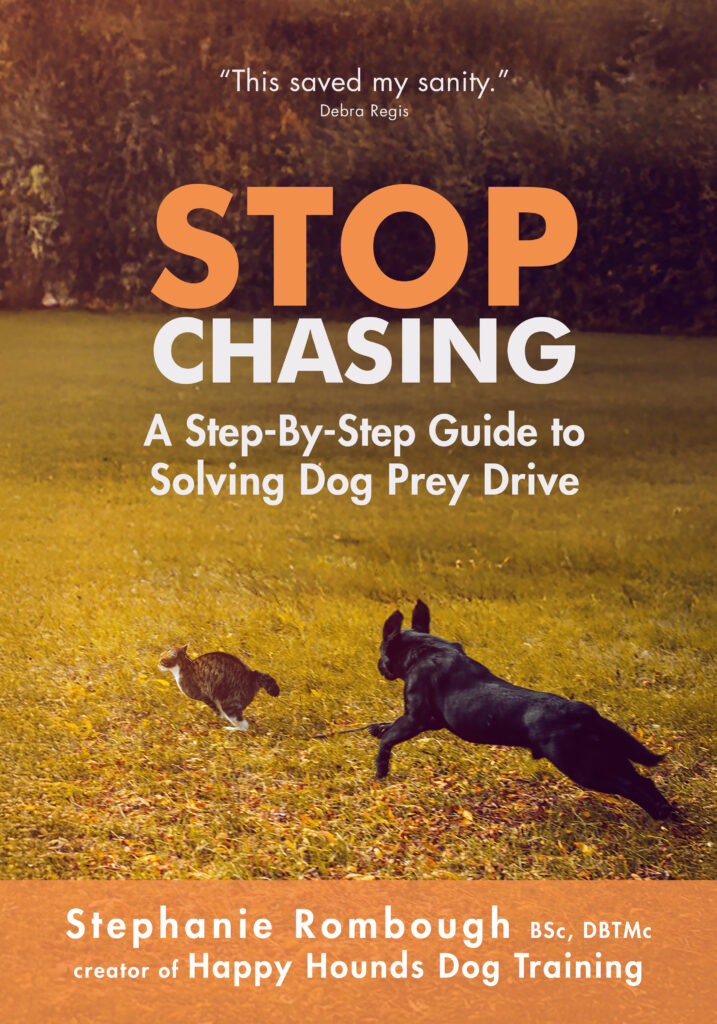
✅ If you want your dog to stop chasing squirrels or bunnies, you can train that!
Management lets you enjoy your walks now while you strategically build those skills for later, without overwhelming yourself or your dog.
It’s not about “avoiding the real world forever.”
It’s about keeping the world at your dog’s training level, until they’re ready for more.
Happy training!
➡ Follow Gus’s full training journey: Gus’s Series: Reactivity Training & Leash Skills
Disclosure: Happy Hounds uses affiliate links. Purchasing with these links will not cost you any extra, but I get commissions for purchases made through these links. Affiliate links help me to continue to offer free resources & blog posts. I would love if you used them!
How to Make Your Dog’s Leash Training Work in the Real World
About the author:





+ show Comments
- Hide Comments
add a comment